

Services
KoderTal delivers production-ready AI solutions, from strategy to scale. We design, build, and integrate AI agents, LLMs, chatbots, and automation that fit your workflow, ship faster, and drive measurable business outcomes globally.


How KoderTal Simplified Estate Planning With One Digital Platform
See how KoderTal replaced a fragmented, manual estate-planning process with one secure, multi-portal digital platform that guides clients, connects partners, and gives administrators complete operational visibility.

How KoderTal Simplified Estate Planning With One Digital Platform
Estate planning is supposed to help people prepare for the future.
But for many clients, the process begins with something far less reassuring: a stack of legal documents, multiple appointments, scattered emails, and unclear next steps.
And one question appearing again and again: "What am I supposed to do now?"
Living trusts, powers of attorney, health directives, property information, family details, payments, and signatures all play an important role in estate planning. But when these steps are spread across different systems and service providers, even a necessary process can become exhausting.
That was the challenge behind one of KoderTal's LegalTech projects.
The client needed more than a digital document folder. They needed an end-to-end platform that could guide individuals through estate planning while helping partners track referrals and giving administrators complete control over operations.
The result was a secure, multi-role estate planning platform designed to replace fragmented workflows with one guided digital experience.
The Real Problem Wasn't the Paper
It would be easy to describe the challenge as a paperwork problem. It was bigger than that.
The traditional process involved complex legal documentation, disconnected service providers, limited visibility, and manual follow-ups. Clients often struggled to understand their progress, while partners and administrators lacked one reliable place to track what had been completed and what still required attention.
The documents were only the visible part of the problem.
Behind them were several operational issues:

Information had to be collected repeatedly.
Progress was difficult to monitor.
Missing documents could cause delays.
Manual communication increased the risk of errors.
Administrators spent valuable time following up instead of supporting clients.
Digitizing a paper form would not solve those problems.
The entire journey needed to be redesigned.
Reality Check
Expectation: "Move the forms online, and the process becomes digital."
Reality: A digital form inside a fragmented workflow is still a fragmented workflow.
Real transformation happens when information, people, documents, payments, communication, and progress tracking work together.
Designing Around the Complete Estate-Planning Journey
KoderTal approached the platform as a connected journey rather than a collection of isolated features.
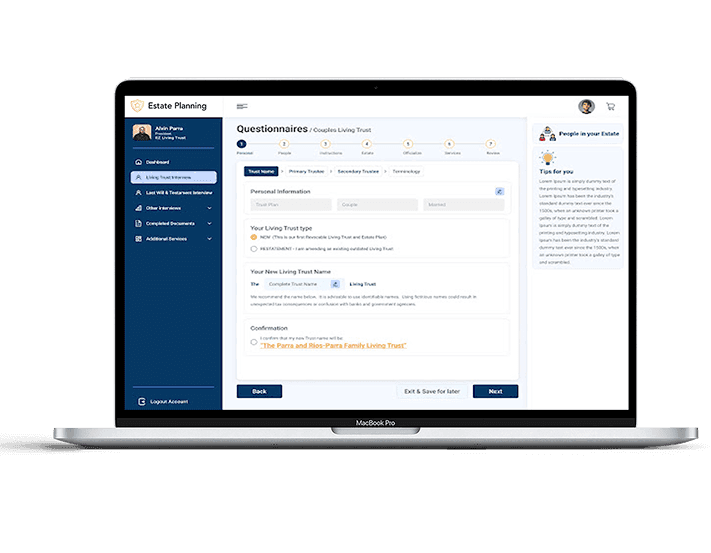
The client experience was organized into a structured seven-step process. Users could register, verify their information, provide family and estate details, complete legal directives, review their information, proceed through checkout, generate documents, and access those documents later. Support was also built into the same experience.
This structure solved one of the biggest challenges in estate planning: uncertainty.
Instead of asking clients to understand the entire legal process at once, the platform presented one clear stage at a time.
Users could see:
Where they were in the process.
What information was required.
What had already been completed.
What action needed to happen next.
That clarity matters.
In sensitive industries, users do not only judge a platform by how quickly it works. They judge it by how confidently it guides them.

One Platform, Three Different Experiences
A major requirement was supporting different user groups without forcing everyone into the same workflow.
The platform therefore included three dedicated portals.
The Client Portal
The client portal handled registration, document submission, guided questionnaires, review, checkout, document access, and support. Its purpose was simplicity. Clients did not need to understand the internal operations behind estate planning. They only needed a clear path through their own responsibilities.
The Partner Portal
Partners could invite clients, monitor referrals, track client progress, and review orders. This gave referral partners visibility without requiring constant emails or manual status requests.
The Admin Portal
The admin portal served as the operational centre of the platform. Administrators could manage users, orders, questionnaires, partners, promo codes, property information, emails, email templates, payments, support requests, and account administrators, all organized around a central dashboard with real-time access to operational data.
This separation was important because reliability does not come from giving everyone access to everything. It comes from giving each user the right tools, information, and permissions for their role.

Automation That Supports People
Legal platforms should not remove people from important decisions. They should remove the repetitive work that prevents people from focusing on those decisions.
The platform automated document generation and stored completed files in one accessible location. It also centralized communication, progress tracking, payments, and administrative data.
This reduced the need to:
Re-enter the same information.
Create documents manually.
Search across disconnected systems.
Send repeated status updates.
Track progress through spreadsheets and email threads.
The goal was not automation for its own sake.
It was to make the experience more reliable for clients and more manageable for the team supporting them.
The Admin Dashboard Became More Than a Dashboard
Many dashboards look impressive but provide little practical value.
This platform's administrative dashboard was designed around decisions and daily work.
Administrators could see active users, orders, and questionnaire progress from one place. They could manage partner approvals, track payments, handle support requests, update reusable email templates, oversee property records, and invite other account administrators.
This changed the dashboard from a reporting screen into an operational workspace.
Instead of asking: "What happened?"
The platform helped administrators answer: "What needs attention now?"
That distinction is what makes software useful in real business environments.

Results That Went Beyond Convenience
The impact was measurable. According to the case study, the platform achieved:
Two hours saved daily
30% fewer errors
25% lower operational overhead
Four times faster reporting
These outcomes came from improving the complete workflow rather than adding one isolated feature.
Automated document creation reduced repetitive work. Centralized dashboards reduced administrative loops. Live tracking reduced uncertainty. Reusable communication tools reduced repeated effort.
And role-specific portals helped clients, partners, and administrators work within the same system without creating confusion.
Reality Check
Expectation: "Digital transformation means replacing paper."
Reality: The real value comes from replacing delays, repeated work, missing visibility, and disconnected decisions.
What KoderTal Learned From Building for LegalTech
Legal technology requires a careful balance. The platform must be simple enough for clients who may be unfamiliar with legal processes, but powerful enough for administrators managing large volumes of information.
It must guide users without overwhelming them. It must automate repetitive work without making the experience feel impersonal. It must improve access while protecting sensitive information. And it must support multiple user roles without allowing workflows to become confusing.
That is why KoderTal's approach extended beyond interface design or document generation. The team built the product around three principles:
Clarity
Users should understand where they are, what is required, and what happens next.
Control
Partners and administrators should have access to the information and tools relevant to their responsibilities.
Continuity
Information, documents, communication, payments, and support should remain connected throughout the complete journey.
These principles are useful far beyond estate planning. Any industry with complex documents, approvals, multiple stakeholders, and sensitive data can benefit from the same product approach.
Technology Should Reduce the Weight of Important Decisions
Estate planning will always involve serious decisions. Technology should not make those decisions feel heavier.
It should create space for people to focus on what matters by removing unnecessary complexity around the process.
For this project, KoderTal helped turn a fragmented estate-planning workflow into one connected platform that supports clients from registration to document access, gives partners clear referral visibility, and allows administrators to manage the operation in real time.
The result was not simply a faster way to complete forms. It was a clearer, more transparent, and more reliable estate-planning experience.
Final Thought
The best digital platforms do not make complex industries look simple by hiding important details. They make complexity manageable by presenting the right information to the right person at the right time.
That is what this estate-planning platform was designed to do.
At KoderTal, we build software that connects people, processes, and information, turning complicated workflows into digital products businesses can confidently operate and users can comfortably navigate.
Ready to modernize a complex workflow?
KoderTal helps LegalTech companies and service providers build secure, scalable platforms that automate repetitive operations, improve visibility, and create better experiences for every user involved.
Ready to Build with KoderTal’s AI Experts?
Talk to our team and turn your next AI idea into a production-ready product