
Vibe Coding Cleanup
Vibe Coding Cleanup: Make AI-Built Code Safe to Ship
AI generated code cleanup for teams who prompted their way to a working product and now cannot change it safely. We audit what is there, put tests around current behaviour, and refactor in slices that keep you shipping.
Hire Engineers to Clean It Up
A look at what the numbers say about the team behind your build.
- 45+
- Engineers
- 50+
- Projects Deployed
- 10+
- Industries Worked In
- 2
- Development Facilities
- 10+
- Years of Experience
- 100+
- Happy Customers
- 24/7
- Support Availability
- 95%
- Client Retention
01 Trusted by
Codebases we have rescued
From venture-backed startups to internal tools that outgrew their origins, these are the products now safe to change.












02 Capabilities
AI Generated Code Cleanup Services
AI generated code cleanup covers an audit, tests, refactoring and guardrails. Together they turn something that works into something you can safely change. We characterise the current behaviour first, so any refactor can be proved not to have broken something that was quietly load bearing.
What is fine-tuning?-
Codebase Audit
What actually exists: architecture, duplication, dead code, dependency risk and the files everyone avoids, with a written verdict on extend versus replace.
What is fine-tuning? -
Security & Secrets Review
Hardcoded keys, missing authorisation checks, unvalidated input and permissive defaults. Generated code is confident about happy paths and quiet about these.
What is fine-tuning? -
Test Harness First
Coverage around what the product does today before anything moves, because a refactor without tests is a rewrite with extra steps.
What is fine-tuning? -
Incremental Refactor
Small reviewable changes that keep the product shippable throughout, no three-month branch and no big-bang cutover.
What is fine-tuning? -
CI & Dependency Guardrails
Pipelines, linting, review rules and dependency policy, so the same drift cannot quietly happen again after we leave.
What is fine-tuning? -
Documentation & Handover
The architecture and the decisions written down, so your team owns the reasoning rather than inheriting the output.
What is fine-tuning?
03 Our process
How AI Generated Code Cleanup Runs
A cleanup runs in six steps, from audit through test coverage and staged refactoring, to a codebase your team owns with confidence. The work happens in slices that keep you shipping, because a three month freeze is rarely a trade a growing product can make.
Get Started-
Codebase Audit
A read of what actually exists: architecture, dependencies, dead code, security exposure and the parts nobody dares touch.
-
Risk & Debt Triage
Findings ranked by what could break a customer versus what is merely ugly, so the first fixes are the ones that matter.
-
Test Harness First
Coverage around current behaviour before anything is refactored, otherwise a rewrite is a rumour rather than a change you can verify.
-
Refactor in Slices
Small, reviewable changes that keep the product shippable throughout. No branch that lives for three months.
-
CI & Guardrails
Pipelines, linting, review rules and dependency policy, so the same drift cannot quietly happen again.
-
Handover & Standards
Documented architecture and conventions your team owns, with the decisions written down rather than remembered.
04 Industries
Cleanup for Regulated Industries
Remediation that closes the gaps an auditor in your sector will look for first.
-
ITSM
IT service management carrying its own weight. Ticket triage, self-service answers & automation, built into the ITSM tools you already run.
9+ Projects -
Legal
Intake to signed file, legal and estate planning document automation built around your practice, with secure client and partner portals.
6+ Projects -
Healthcare
HIPAA compliant by design, not by patch. Clinical documentation, intake and patient records software for the EHR you already use.
10+ Projects -
Real Estate
Property moves fast and the software should keep up. Real estate platforms for listings, valuations and the agent workflows underneath.
7+ Projects -
Construction
Built for the site, not just the office. Construction estimating and field reporting software that connects to what crews already carry.
8+ Projects -
Logistics
Every hour costs money in logistics. Dispatch, tracking and exception handling software that lets operators act before a load slips.
6+ Projects






05 Case studies
Rescues we have delivered
Products that went from untouchable to shippable.
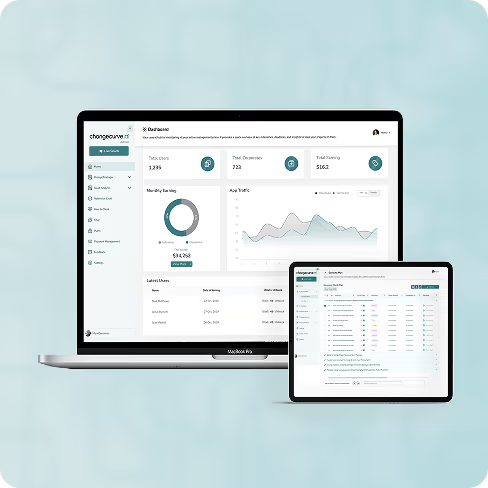
Change Management
AI-Powered Enterprise Change Management for Large-Scale Organizations
Enterprise change management software letting organisations execute, monitor and sustain change faster, with the progress of every initiative visible in one place.
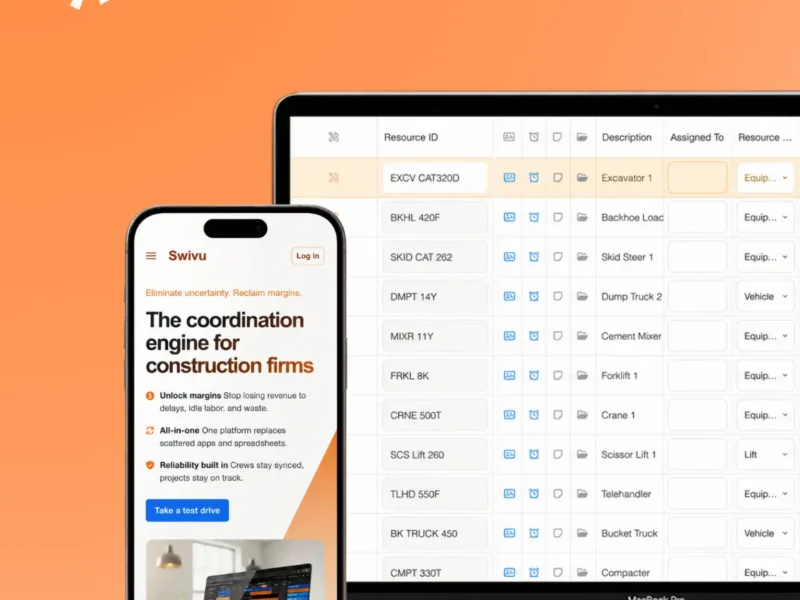
Construction Management
Real-Time Construction Coordination, From HQ to Field
A construction coordination platform for multi site work, replacing spreadsheets and scattered email with tasks, schedules and on site progress synced in real time.
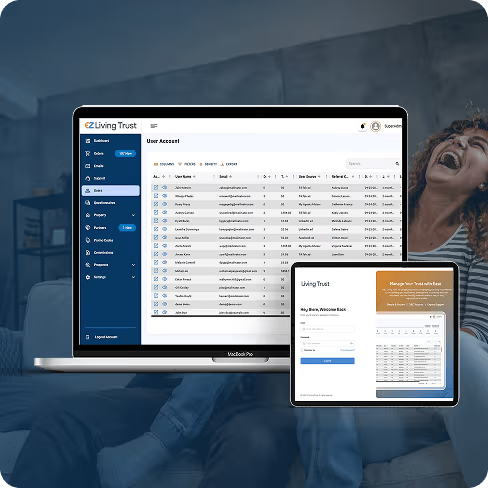
Legal & Estate Planning
Building a Secure, Multi-Portal Legal Platform
A digital estate planning platform running end to end across three portals, simplifying legal documentation and improving transparency for every party to a trust.
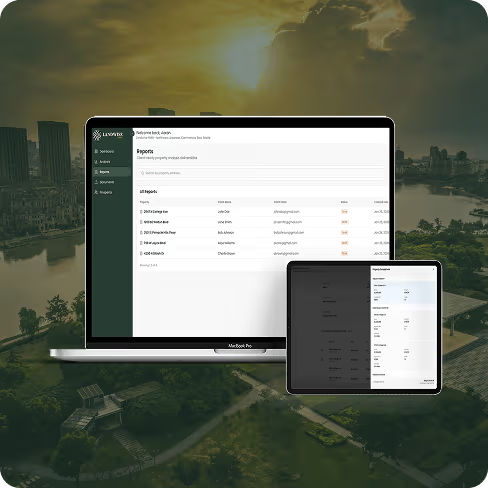
AI Based Real Estate Property
AI-Driven Property Insights Platform
Landwise NWA transforms commercial real estate workflows by providing AI-powered insights and data integration for faster decisions.
AI Automation
AI-Powered Content Automation Platform
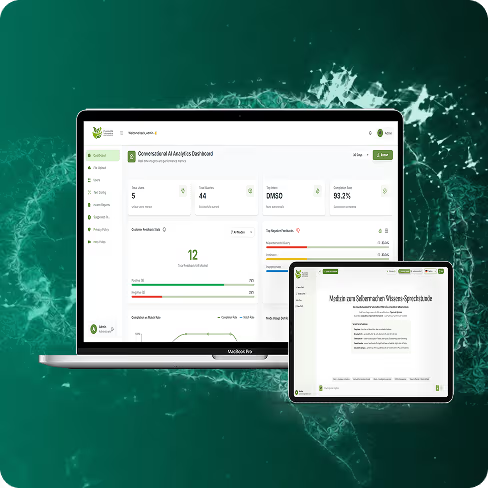
An AI content engine that turns sales and strategy calls into ready-to-post content, matched to the brand's own voice and scheduled straight to LinkedIn.
07 Tech stack
What we work in
The frameworks, platforms and tooling we audit and refactor across.
- OpenAI
- Claude
- Gemini
- Llama 3
- Mistral
- Falcon
- LangChain
- LlamaIndex
- Haystack
- DSPy
- LoRA
- PEFT
- Axolotl
- Unsloth
- Pinecone
- Weaviate
- pgvector
- Qdrant
- Chroma
- OpenAI API
- Anthropic API
- Vertex AI
- Bedrock
- LangSmith
- Langfuse
- Arize
- Helicone
- Guardrails AI
- NeMo Guardrails
- Presidio
- Streamlit
- Chainlit
- Next.js
- Vercel AI SDK
08 Challenges
What AI-built codebases get wrong
AI built codebases tend to share the same problems: duplicated logic nobody consolidated, no tests describing intended behaviour, secrets and permissions handled inconsistently, and dependencies added by whichever prompt happened to need them. We take each one in order of what would hurt most if it failed.
Nobody can explain how it works
The same logic in six places
Secrets and missing auth checks
No tests, so no safe changes
Dependencies nobody chose
It broke the moment it grew
09 Advantages
Why Teams Call Us for AI Generated Code Cleanup
Teams call us because we keep them shipping through the cleanup and leave guardrails behind so the drift cannot quietly return. Tests, review rules and dependency checks stay in place after we go, which is what stops the same problem reappearing in six months.
-
You Keep Shipping
Refactoring happens in small reviewable slices behind your normal release process, so the product stays live throughout. No freeze, no long-lived branch.
-
Tests Before Changes
We characterise current behaviour first, which is the only way to prove a refactor changed structure and not function.
-
Security Looked At Deliberately
Secrets, authorisation and input validation get a dedicated pass, because these are the specific things generated code is reliably weakest on.
-
An Honest Verdict
Sometimes the answer is replace rather than rescue, and we will say so in the audit with the reasoning, before you have paid for a refactor.
-
Guardrails That Outlast Us
CI, linting, review rules and dependency policy, so the codebase cannot quietly drift back once your team is on its own.
-
Handed Over, Not Held
Documented architecture and conventions your team owns. The goal is that you do not need us again.
10 More services
What else we build
The rest of what we build, and the teams who build it.
- Business Process Automation We automate the repeatable parts of a process, from document intake to decisions and handoffs, with an exception path designed before the happy path.
- AI Consulting A short discovery that identifies high-impact use cases, reviews your data and systems, and returns a phased roadmap with costs and risks attached.
- AI Integration We wire AI into the systems you already run, with identity, data, latency and failure behaviour designed before anything ships.
- Chatbot Development Assistants that answer from your own content, hand off cleanly to a person, and log every conversation for review.
- Generative AI Consulting A short engagement that finds where generative AI pays for itself in your business, and where it does not.
- Generative AI Development We design and integrate large language model features into your product, with retrieval, evaluation harnesses, and prompt governance in place before launch.
- AI Agent Development Assistants and autonomous agents that work inside your systems, handling support, intake, and internal workflows with human handoff where it matters.
- IT Staff Augmentation Senior engineers who join your sprints, tools, and review process, so capacity goes up without your team losing control of priorities.
- AI Copilot Development Copilots built into your product, so the assistant works where your users already are rather than in a separate window.
- Machine Learning Development Forecasting, classification, and computer vision models trained on your data, deployed with monitoring so accuracy is measured rather than assumed.
- Machine Learning Consulting An assessment of whether the signal you need exists in your data, and what a model would actually be worth.
- SaaS Development Multi-tenant products built to be sold: billing, permissions, onboarding and the operational work that comes after launch.
11 FAQ
Frequently asked questions
The things teams ask before starting with us.
AI generated code cleanup starts with an audit and a set of tests describing what the system currently does. Refactoring then happens in slices that keep you shipping, and guardrails stay in place afterwards so the same drift cannot quietly return in six months.
Sometimes, and the audit answers it honestly. The deciding factors are usually whether the data model is sound and whether authorisation can be centralised, if both are salvageable, incremental refactoring is almost always cheaper and far less risky, because you keep shipping. If they are not, we will say replace, and scope it in slices rather than as a big-bang rewrite.
Less than the current state does. The first two weeks are audit and tests, which produces no features, after that, cleanup runs alongside feature work in the same sprints. Most teams find velocity improves within a month or two, because changes stop causing unrelated breakages.
We start with a short discovery call to clarify goals, constraints, and success metrics. Then we identify high-impact AI use cases, review your data and systems, and propose a phased roadmap with costs and risks attached to each phase.
Discovery runs 2 to 4 weeks, an MVP typically lands in 8 to 16 weeks of weekly-demo sprints, and operate is an ongoing arrangement with monitoring and support after launch.
Fixed-scope work is priced per milestone, dedicated teams are billed monthly per seat, and staff augmentation is weekly or monthly. You pick the model that fits and can switch between phases. There is a fuller breakdown of what moves the number on our AI development cost page.
You do. The full repository, documentation, and deployment transfer to you at every milestone, with no lock-in to us.
NDAs from day one, scoped access, and data residency decided at the architecture stage. We work within HIPAA, SOC 2, and similar requirements where they apply.
We monitor accuracy, cost, and uptime, run regression checks as models drift, and keep a defined escalation path with support so the system stays healthy after release.
12 Book a Call
Ready to book an audit?
Tell us where you are and what has to be true for this to work. We come back with an approach, a timeline and a number.
- 2451 West Grapevine Mills Circle , Grapevine, TX 76051 · USA , +1 (424) 304-1086 ,
- info@kodertal.com
- Reply within 1 business day, 24/7 support once live