
AI Copilot Development
AI Copilot Development, Built Into Your Product
AI copilot development that puts the assistant inside your interface rather than beside it. It already knows what the user is looking at, suggests the next action in place, and lets them accept or reject it.
Hire Dedicated Copilot Engineers
A look at what the numbers say about the team behind your build.
- 45+
- Engineers
- 50+
- Projects Deployed
- 10+
- Industries Worked In
- 2
- Development Facilities
- 10+
- Years of Experience
- 100+
- Happy Customers
- 24/7
- Support Availability
- 95%
- Client Retention
01 Trusted by
Products we put copilots into
From venture-backed SaaS to enterprise platforms, these are the products whose users now have help in place.












02 Capabilities
AI Copilot Development Services
AI copilot development covers context, suggestion, review and measurement. Those four decide whether people accept a copilot or quietly ignore it. We build the assistant inside your interface, so it already knows what the user is looking at and can suggest the next action in place.
Get Started-
In-Product Context Awareness
The copilot knows the record, selection and permissions of whoever is asking, so help is specific rather than generic and never leaks across tenants.
Get Started -
Suggested Actions
Concrete next steps the user can accept, edit or reject in one click, rather than a paragraph telling them what they could do.
Get Started -
Inline Generation & Editing
Drafting and rewriting where the content already lives, with diffs the user reviews before anything is saved.
Get Started -
Human-in-the-Loop Review
Nothing consequential happens without an accept step, and every acceptance is recorded, which is what makes a copilot usable in a regulated workflow.
Get Started -
Acceptance Analytics
Which suggestions get taken, which get edited and which get dismissed, reported per surface, so the roadmap follows what users actually use.
Get Started -
Progressive Disclosure
Help that appears where it is relevant instead of a permanent panel, so the copilot earns attention rather than demanding it.
Get Started
03 Our process
How an AI Copilot Development Build Runs
A copilot build runs in seven steps, from requirements through context design, suggestion quality, review flow and rollout, to the measurement that tells you whether people accept what it offers. Each step produces something you can try inside your own product before the next one starts.
Get Started-
Requirements Analysis
We start by understanding your clinical workflows, stakeholders, and constraints. Our team documents use cases, success metrics, data sources, and PHI boundaries, then defines responsibilities and approvals. This creates a clear scope that prevents surprises and reduces rework.
-
AI Strategy & Roadmap
We translate priorities into a phased roadmap with measurable KPIs, timelines, and risk controls. Our plan covers model choices, retrieval needs, integrations, and rollout steps. You get a practical sequence that leadership can approve and teams can execute.
-
Model Design & Development
We design the right approach, whether LLM, ML or hybrid, then build prompts, tools and pipelines. We create evaluation datasets, define pass and fail thresholds, and iterate with weekly demos. The goal is reliable behaviour across real clinical and operational scenarios.
-
Integration With Existing Systems
We integrate with EHR-adjacent systems, CRMs, ticketing, and data platforms through secure APIs and middleware. We add RBAC, audit logs, rate limits, and fallbacks. Integrations are staged and reversible, protecting production workflows during rollout.
-
Testing & Compliance Checks
We test functional accuracy, edge cases, privacy controls, and workflow safety before launch. Our checks include auditability, access rules, and documentation for review. We validate performance under load and confirm outputs stay grounded and clinically appropriate.
-
Deployment
We deploy through CI/CD with monitoring, alerts, and rollout controls. Our team validates behaviour in production, watches the first weeks closely, and keeps a rollback path open until the new workflow has settled.
-
Support & Optimization
We monitor drift, cost, and accuracy after launch, and tune retrieval, prompts, and thresholds as guidelines change. You get documented systems and a named team that remembers the reason behind each decision.
04 Industries
Copilots for Regulated Industries
In-product assistance that keeps the human accountable where the rules require it.
-
ITSM
IT service management carrying its own weight. Ticket triage, self-service answers & automation, built into the ITSM tools you already run.
9+ Projects -
Legal
Intake to signed file, legal and estate planning document automation built around your practice, with secure client and partner portals.
6+ Projects -
Healthcare
HIPAA compliant by design, not by patch. Clinical documentation, intake and patient records software for the EHR you already use.
10+ Projects -
Real Estate
Property moves fast and the software should keep up. Real estate platforms for listings, valuations and the agent workflows underneath.
7+ Projects -
Construction
Built for the site, not just the office. Construction estimating and field reporting software that connects to what crews already carry.
8+ Projects -
Logistics
Every hour costs money in logistics. Dispatch, tracking and exception handling software that lets operators act before a load slips.
6+ Projects






05 Case studies
Copilots we have shipped
Assistance built into products people use daily.
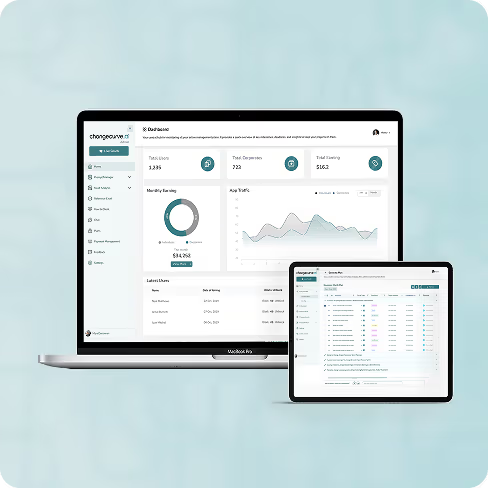
Change Management
AI-Powered Enterprise Change Management for Large-Scale Organizations
Enterprise change management software letting organisations execute, monitor and sustain change faster, with the progress of every initiative visible in one place.
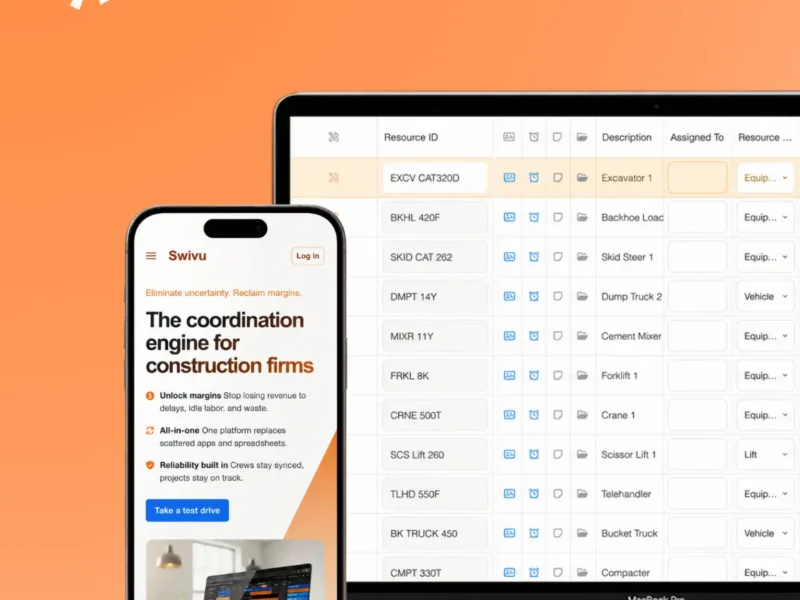
Construction Management
Real-Time Construction Coordination, From HQ to Field
A construction coordination platform for multi site work, replacing spreadsheets and scattered email with tasks, schedules and on site progress synced in real time.
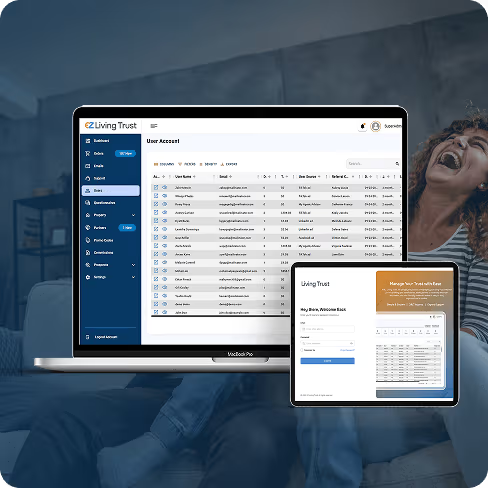
Legal & Estate Planning
Building a Secure, Multi-Portal Legal Platform
A digital estate planning platform running end to end across three portals, simplifying legal documentation and improving transparency for every party to a trust.
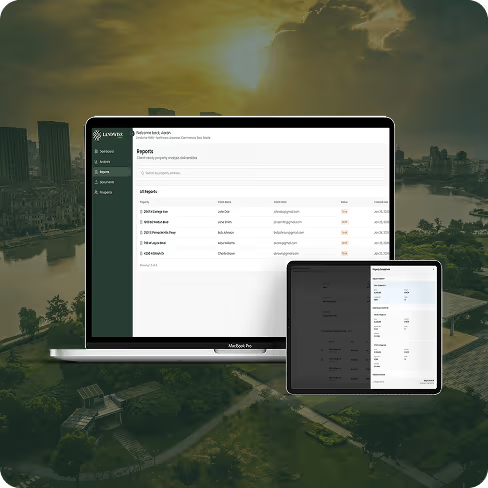
AI Based Real Estate Property
AI-Driven Property Insights Platform
Landwise NWA transforms commercial real estate workflows by providing AI-powered insights and data integration for faster decisions.
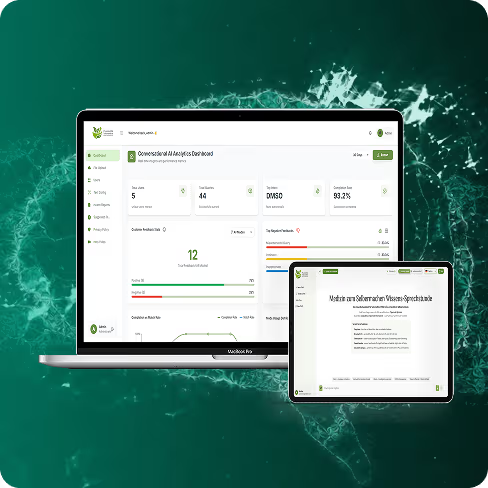
AI Automation
AI-Powered Content Automation Platform
An AI content engine that turns sales and strategy calls into ready-to-post content, matched to the brand's own voice and scheduled straight to LinkedIn.
06 Client review
Dominik Dietz Review
KoderTal built an AI-powered chatbot integrated into our holistic health education platform. Basic support inquiries have decreased by approximately 20%–30% and user engagement has noticeably improved.
 Dominik Dietz
Holistic Health Teacher
Dominik Dietz
Holistic Health Teacher
Clutch 5.0
07 Tech stack
The copilot stack we build on
Proven models, frameworks and tooling for in-product assistance.
- OpenAI
- Claude
- Gemini
- Llama 3
- Mistral
- Falcon
- LangChain
- LlamaIndex
- Haystack
- DSPy
- LoRA
- PEFT
- Axolotl
- Unsloth
- Pinecone
- Weaviate
- pgvector
- Qdrant
- Chroma
- OpenAI API
- Anthropic API
- Vertex AI
- Bedrock
- LangSmith
- Langfuse
- Arize
- Helicone
- Guardrails AI
- NeMo Guardrails
- Presidio
- Streamlit
- Chainlit
- Next.js
- Vercel AI SDK
08 Challenges
Why copilots get ignored
Copilots get ignored when suggestions arrive without context, when accepting one costs more effort than doing the task by hand, or when users cannot see what changed. We design the review step first, measure acceptance rather than engagement, and make every suggestion reversible before it is offered.
A chat window bolted to the corner
Suggestions with no accept button
Measured on engagement, not acceptance
Context that leaks across tenants
Always-on panel nobody asked for
Silent writes
09 Advantages
Why Teams Pick Us for AI Copilot Development
Teams pick us for copilots because we measure assistance on acceptance rather than on engagement. A suggestion nobody takes is a failure even if it was shown a thousand times. Everything the copilot proposes stays reviewable before it acts, so trust is earned rather than assumed.
-
Context Before Conversation
The copilot starts from what the user is looking at and who they are, so the first response is useful without a paragraph of explanation.
-
Acceptance Is the Metric
We report accept, edit and dismiss rates per surface rather than message volume, because only one of those says the feature is working.
-
Nothing Acts Without Review
Consequential changes are always proposed and accepted, never applied silently, and every acceptance is recorded.
-
Tenant Isolation Enforced
Retrieval is scoped to the signed-in user's permissions server-side, so cross-tenant leakage is structurally impossible rather than unlikely.
-
Earns Its Screen Space
Help appears where it is relevant instead of occupying a permanent panel, which is what stops it being collapsed and forgotten.
-
Built Into Your Front End
We work in your components and your design system, so the copilot looks like part of the product rather than an embedded widget.
10 More services
What else we build
The rest of what we build, and the teams who build it.
- SaaS Development Multi-tenant products built to be sold: billing, permissions, onboarding and the operational work that comes after launch.
- Mobile App Development iOS and Android apps built for the store review and the years after it, not just the demo.
- AI Agent Development Assistants and autonomous agents that work inside your systems, handling support, intake, and internal workflows with human handoff where it matters.
- Generative AI Development We design and integrate large language model features into your product, with retrieval, evaluation harnesses, and prompt governance in place before launch.
- AI Integration We wire AI into the systems you already run, with identity, data, latency and failure behaviour designed before anything ships.
11 FAQ
Frequently asked questions
The things teams ask before starting with us.
AI copilot development puts the assistant inside the interface a user is already working in, so it knows what they are looking at and can suggest the next action in place. A chatbot waits to be asked a question. A copilot acts on context the user never has to explain.
A chatbot is a conversation you go to; a copilot is help that comes to you. The copilot already knows the record you are on and what you are permitted to see, and it proposes actions you accept in place. Practically, the difference shows up in acceptance rate, copilots are used because they cost the user nothing to try.
Yes, we build in your components and design system rather than dropping in an iframe, which is what makes a copilot feel native. We need access to your context (current record, selection, user permissions) through your own state layer; if that is not exposed yet, surfacing it is usually a small piece of groundwork we scope up front.
We start with a short discovery call to clarify goals, constraints, and success metrics. Then we identify high-impact AI use cases, review your data and systems, and propose a phased roadmap with costs and risks attached to each phase.
Discovery runs 2 to 4 weeks, an MVP typically lands in 8 to 16 weeks of weekly-demo sprints, and operate is an ongoing arrangement with monitoring and support after launch.
Fixed-scope work is priced per milestone, dedicated teams are billed monthly per seat, and staff augmentation is weekly or monthly. You pick the model that fits and can switch between phases. There is a fuller breakdown of what moves the number on our AI development cost page.
You do. The full repository, documentation, and deployment transfer to you at every milestone, with no lock-in to us.
NDAs from day one, scoped access, and data residency decided at the architecture stage. We work within HIPAA, SOC 2, and similar requirements where they apply.
We monitor accuracy, cost, and uptime, run regression checks as models drift, and keep a defined escalation path with support so the system stays healthy after release.
12 Book a Call
Ready to scope your copilot?
Tell us where you are and what has to be true for this to work. We come back with an approach, a timeline and a number.
- 2451 West Grapevine Mills Circle , Grapevine, TX 76051 · USA , +1 (424) 304-1086 ,
- info@kodertal.com
- Reply within 1 business day, 24/7 support once live