Custom AI software development is the work of building AI features, such as language models, predictive models or AI agents, into software designed around your own data, workflows and rules. A focused first build usually costs $5,000 to $25,000 for an AI feature in an existing product, or $45,000 to $100,000 for a new AI-powered product, after a short discovery phase. It pays off when the problem is specific to your business, the data exists, and you can name the number you want to move before anyone writes code.
We work in AI custom software development every day, so this guide skips the hype. You’ll get the real process, honest cost ranges, the tradeoffs nobody puts in a sales deck, and a quick test for deciding whether to build, buy or wait.
“Clients expect the model to be the hard part. It almost never is. The work that decides success is the data, the permissions and the path for the cases the AI can’t handle.”
Key takeaways
- What it is: software where AI runs inside the product (document extraction, support assistants, forecasting, agents), shaped around your data instead of a vendor’s defaults.
- Typical cost (2026): $5k–$25k for discovery, $5k–$25k to add an LLM feature to an existing product, $45k–$100k for an AI-powered MVP, $100k–$250k for regulated enterprise platforms.
- Running cost: budget 15–25% of the build cost per year for monitoring, model updates and inference, plus usage-based model fees.
- Timeline: 2–4 weeks discovery, 8–16 weeks to a production MVP.
- It’s worth it when: the workflow is unique to you, the data is available and legally usable, and a pilot can prove value on real cases within 90 days.
- Skip it when: an off-the-shelf tool covers 80% of the need, or nobody will own the system after launch.
- Biggest risk: data that isn’t AI-ready, not the choice of model.
The numbers behind custom AI in 2026
- 37% of organizations attribute any EBIT impact to AI, essentially flat from last year, even as adoption keeps rising (McKinsey, The State of AI in 2026).
- 32% of organizations decided against buying at least one software product because they could build it in-house with agentic coding tools (McKinsey, 2026).
- 1 in 5 organizations say AI operating costs, including token costs, are limiting how much they use AI (McKinsey, 2026).
- About 6% of companies qualify as AI high performers, and they stand out for redesigning workflows around AI rather than bolting AI onto old ones (McKinsey, 2026).
- 60% of AI projects without AI-ready data will be abandoned through 2026, and 63% of organizations lack or aren’t sure they have the right data practices (Gartner).
- Over 40% of agentic AI projects will be canceled by the end of 2027 due to rising costs, unclear value or weak risk controls (Gartner).
What is custom AI software development?
Custom AI software development, sometimes called custom artificial intelligence software development, means designing, building and running AI capabilities inside software made for one organization. The AI isn’t a separate subscription your team logs into. It sits in the workflow: a claims screen that scores risk as a file arrives, or a help desk that resolves routine tickets before an agent sees them.
Every system like this combines three layers. There’s the application people actually use, one or more AI models, and your business data. That last layer is what makes the output useful to you rather than generic.
It’s also a branch of custom software development, which matters more than it sounds. Most AI projects fail on ordinary engineering problems like permissions, integrations and error handling, not on the AI itself.
How is it different from AI-assisted software development?
AI-assisted development uses AI to help engineers write code faster, while custom AI software puts AI inside the finished product. Search results mix these up constantly, so here’s the difference side by side.
| Question | AI-assisted development | Custom AI software |
|---|---|---|
| Where the AI lives | In the developer’s editor | In the running application |
| Who benefits | The engineering team | Customers, operators, staff |
| Examples | Code completion, test generation, code review help | Document extraction, support assistants, fraud scoring, agents |
| Main risk | Unreviewed code reaching production | Wrong answers, data leaks, model drift |
| What you’re buying | Speed | A new capability |
Swipe sideways to see the full table.
The two overlap more each year. If your team already shipped a prototype with an AI coding tool and it’s getting shaky, a cleanup of the AI-built codebase is often cheaper than starting over.
What are the key features of custom AI software?
Good custom AI software is grounded in your data, measured before launch, and built to fail safely. Those three traits separate a production system from a demo. In practice, that means these features:
- Retrieval grounding: answers come from your documents and records, with the source attached, so people can check them.
- An evaluation set: a few hundred real, messy cases the system must pass before every release. A demo on ten clean examples proves nothing.
- Permission-aware data access: the AI only sees what the current user is allowed to see. This is the feature most prototypes skip.
- Human approval gates: anything with money, legal or customer impact waits for a person to confirm.
- An exception path: a designed route for the cases the AI can’t handle. We build this before the happy path, because it decides whether staff trust the system.
- Cost controls: model routing, caching and usage caps so inference bills don’t scale faster than value.
- Monitoring and audit logs: every input, output and action is recorded, so drift shows up in a dashboard instead of a complaint.
Which business problems do custom AI solutions actually solve?
Custom AI solutions earn their cost on high-volume, judgment-light work where the rules are fuzzy but the patterns are real. Here’s how common problems map to solutions and the metric that proves each one works.
| Problem | Custom AI solution | Metric to track |
|---|---|---|
| Staff re-type data from invoices, contracts or forms | Document AI that extracts fields into your system of record | Documents per hour, field error rate |
| Support queues full of repeat questions | Assistant grounded in your help content, with human handoff | Share resolved without an agent, CSAT |
| L1 and L2 IT tickets pile up | Triage and resolution copilot inside the ITSM console | Time to resolution, ticket automation rate |
| Delays and churn spotted too late | Predictive models on historical data | Forecast accuracy, losses prevented |
| Multi-step back-office tasks across systems | An AI agent with tool access and approval gates | Cost per completed task, escalation rate |
Swipe sideways to see the full table.
One real example: our AI service desk build automates about 60% of tickets with 95% answer accuracy, inside the ServiceNow and Ivanti screens agents already use. Keeping it inside existing tools did more for adoption than any model upgrade.
How does the custom AI software development process work, step by step?
The custom AI software development process runs in seven stages, from a measurable goal to a monitored production system. Skipping a stage rarely saves time; it just moves the rework later, where it costs more.
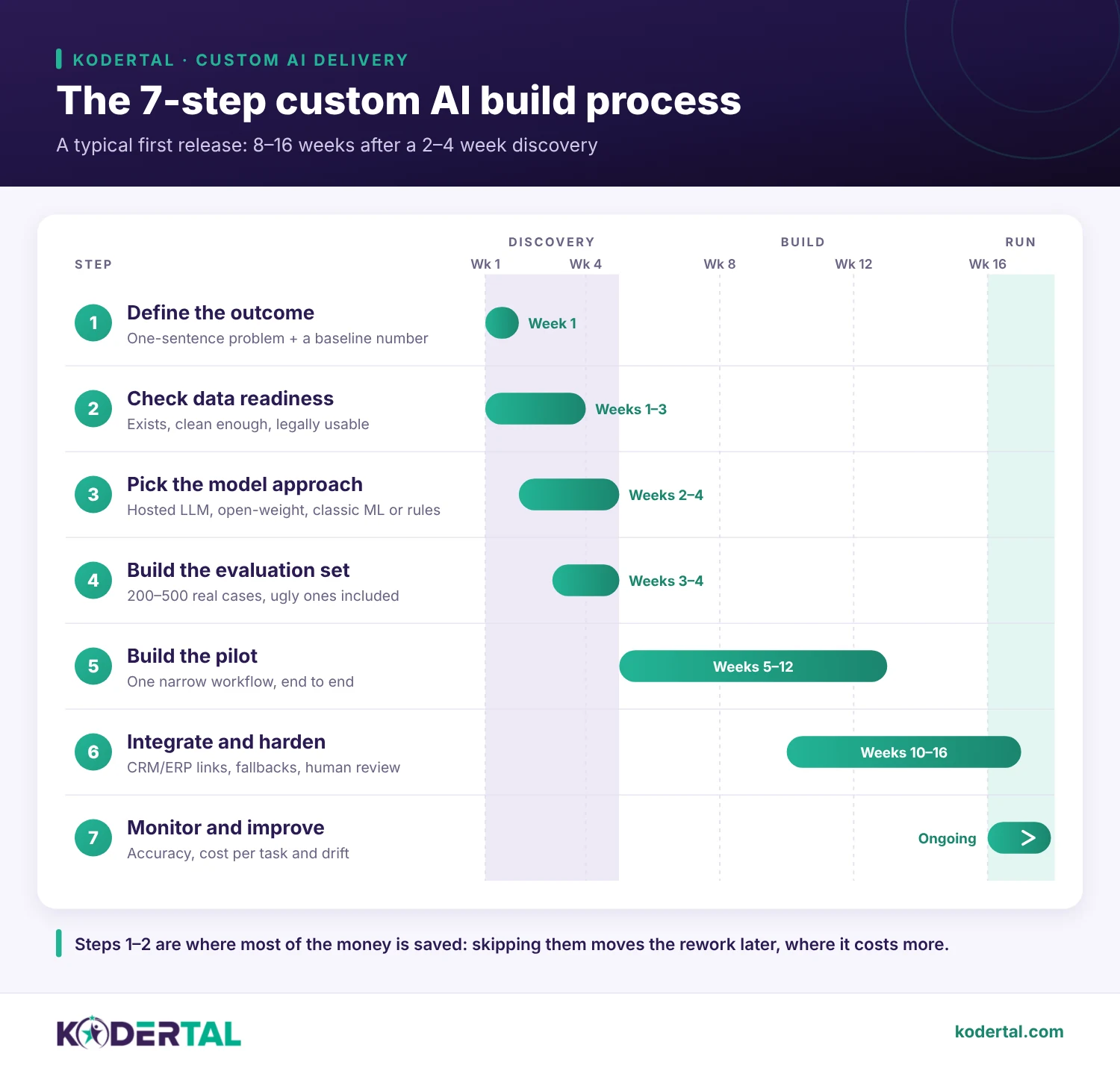
- Define the outcome (week 1). Write the business problem in one sentence without the word “AI,” then attach a baseline number, such as “it takes 14 minutes to process one claim today.”
- Check data readiness (weeks 1–3). Confirm the data exists, is clean enough, and is legally usable. This step kills or reshapes more projects than any other, and that’s a good outcome when it happens early.
- Pick the model approach (weeks 2–4). Choose between a hosted LLM, an open-weight model, classic machine learning, or plain rules. Many “AI” problems are best solved with a well-built rules engine.
- Build the evaluation set (weeks 3–4). Collect 200 to 500 real cases, including the ugly ones, and agree on what “correct” means with the people who do the work today.
- Build the pilot (weeks 5–12). Ship one narrow workflow end to end, with the exception path, logging and permissions in place from the first release. Weekly demos keep scope honest.
- Integrate and harden (weeks 10–16). Connect to your CRM, ERP or ticketing tools, add fallbacks for timeouts, and roll out to a small group with human review switched on.
- Monitor and improve (ongoing). Track accuracy, cost per task and drift. Retrain or adjust prompts when the numbers slip, not when users complain.
The first two steps are where most of the money is saved. We wrote more about this in how better discovery removes the speed-versus-quality tradeoff.
How much does custom AI software development cost in 2026?
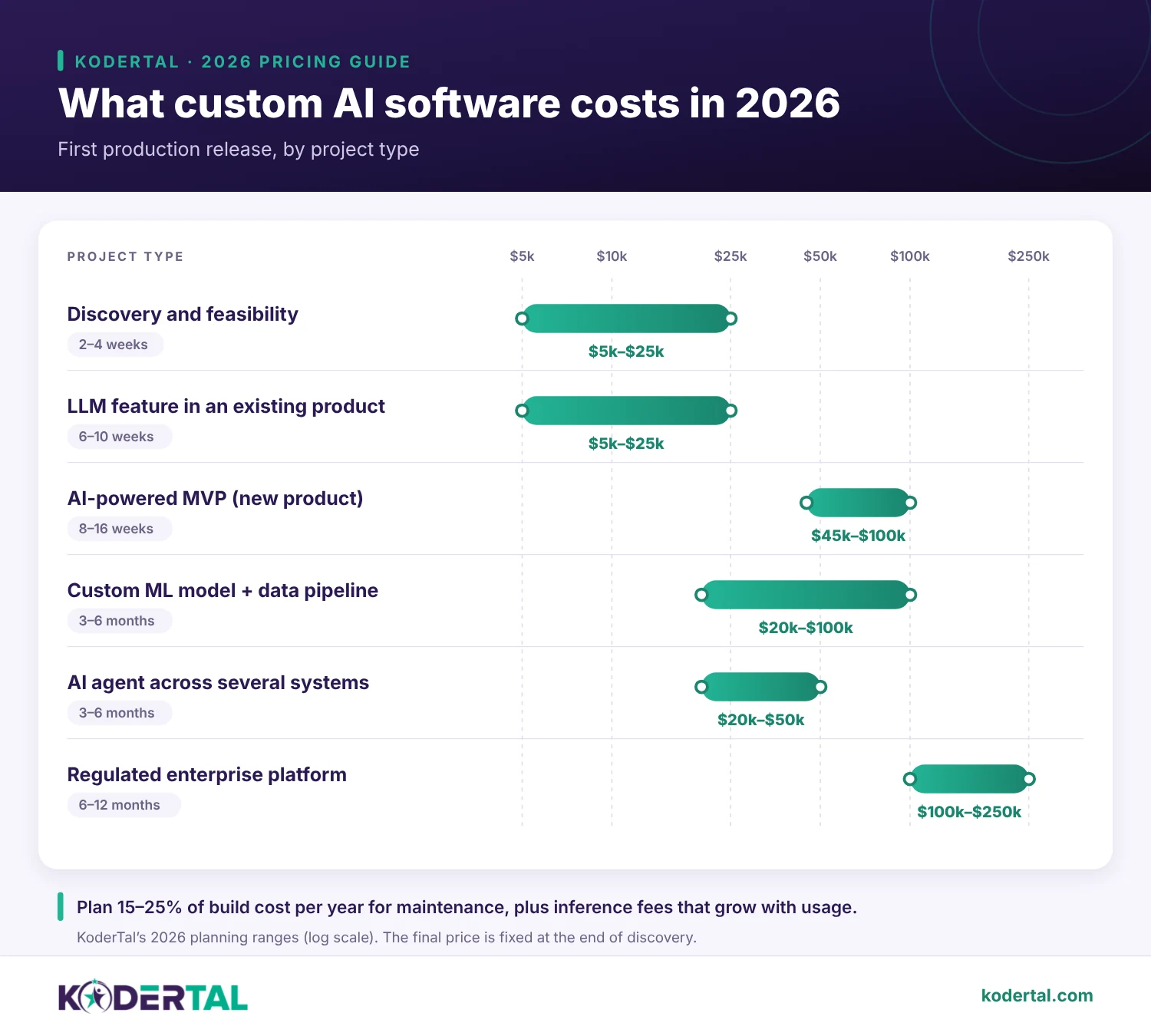
Most custom AI software development projects cost between $5,000 and $100,000 for a first production release, with regulated enterprise platforms running $100,000 to $250,000. Scope, data condition and integrations drive the number far more than model choice does.
These AI custom software development ranges reflect KoderTal’s 2026 rates and the projects we see most often. Treat them as planning numbers, not quotes.
| Project type | Typical cost | Timeline | What’s included |
|---|---|---|---|
| Discovery and feasibility | $5k–$25k | 2–4 weeks | Use-case ranking, data review, architecture, costed roadmap |
| LLM feature in an existing product | $5k–$25k | 6–10 weeks | Retrieval pipeline, eval set, guardrails, one integration |
| AI-powered MVP (new product) | $45k–$100k | 8–16 weeks | App, AI layer, auth, admin, monitoring |
| Custom ML model with data pipeline | $20k–$100k | 3–6 months | Data engineering, training, serving, drift monitoring |
| AI agent across several systems | $20k–$50k | 3–6 months | Tool integrations, approval gates, audit logs, fallbacks |
| Regulated enterprise platform | $100k–$250k | 6–12 months | Compliance controls, multi-team rollout, SLAs |
Swipe sideways to see the full table.
For our current rates and engagement pricing, see the AI development cost and rates page.
What hidden costs do most estimates leave out?
In AI custom software development, the costs that surprise buyers are running costs, data work and evaluation, not the initial build. Watch for these line items in any proposal:
- Inference and token fees: they grow with usage. McKinsey’s 2026 survey found one in five organizations already limiting AI use because of operating costs.
- Data cleanup and labeling: often 20–40% of total effort when data is scattered across systems.
- Evaluation: building and maintaining the test set is real work, and it’s the first thing cut from cheap quotes.
- Maintenance: model providers deprecate versions, prompts drift, and integrations change. Plan 15–25% of build cost each year.
- Change management: training and workflow redesign. McKinsey’s high performers spend heavily here, and it shows in their results.
Is custom AI development worth it?
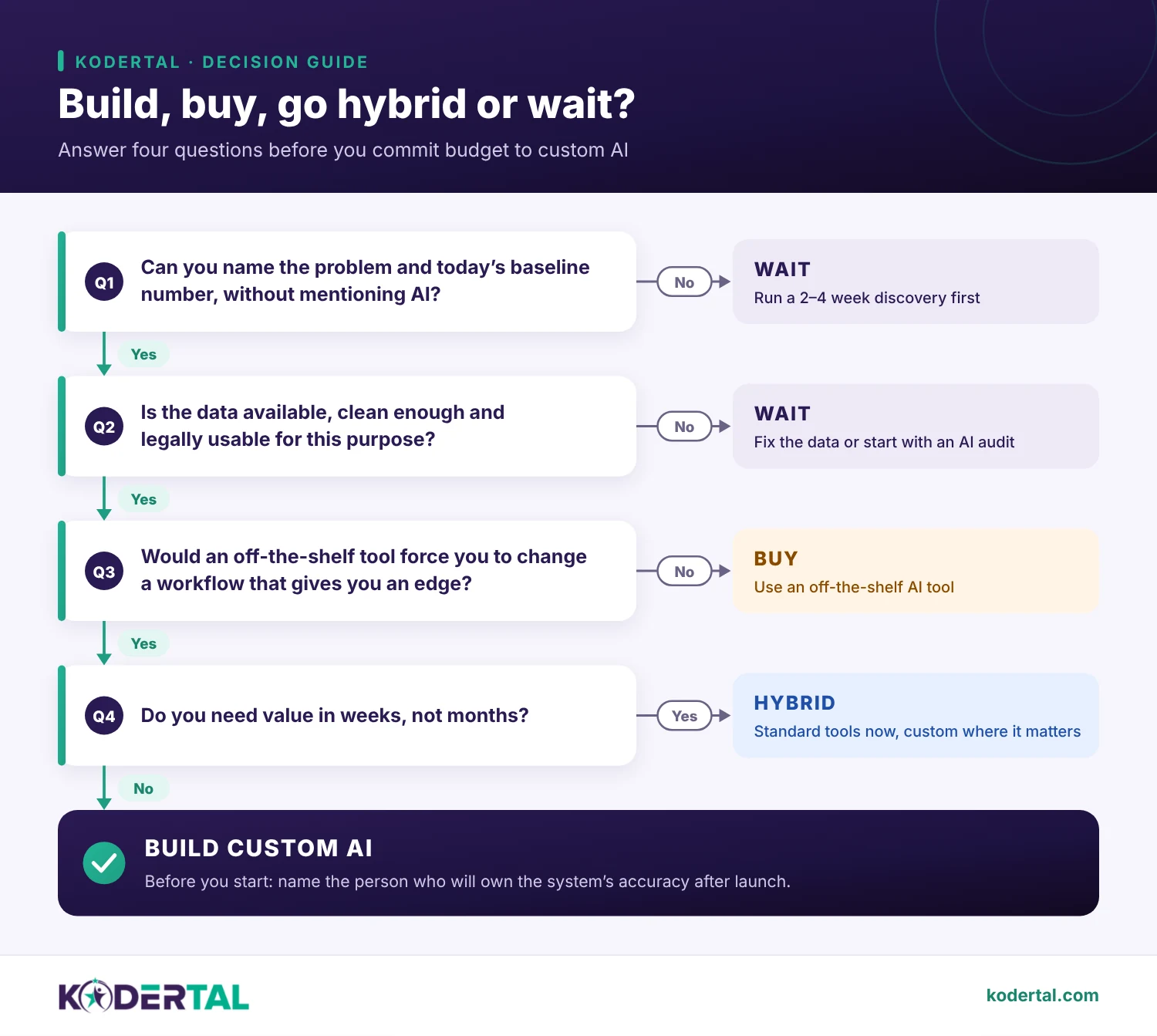
Custom AI development is worth it when it moves a number you already track, on a workflow no vendor tool fits, using data you control. If any of those three is missing, start with an off-the-shelf tool or a discovery phase instead.
Run this five-question test before you commit budget. Three or more “no” answers means wait.
- Can you describe the problem in one sentence without mentioning AI?
- Do you have today’s baseline for the metric you want to move?
- Is the data available, reasonably clean and legally usable for this purpose?
- Would an off-the-shelf tool force your team to change a workflow that gives you an edge?
- Will a named person own the system’s accuracy after launch?
The math has shifted in custom builds’ favor. With 32% of organizations now skipping software purchases because they can build in-house, the old rule of “always buy unless you’re huge” no longer holds for narrow, workflow-specific tools.
Why is the model usually the cheapest part of a custom AI build?
The model is usually the smallest cost in custom artificial intelligence software development, and that runs against what most buyers expect. Here’s what most guides get wrong: they treat model selection as the big decision, when frontier models from OpenAI, Anthropic and Google now perform close enough that switching between them is a configuration change.
Where the money really goes is data pipelines, permission handling, integrations, evaluation and the exception path. So be wary of any proposal that leads with “we’ll train a custom model.” In 2026, most good custom AI software uses an existing model and puts the custom work around it. Training your own model makes sense only when you have proprietary data at scale and a task general models measurably fail at.
Custom AI vs off-the-shelf vs hybrid: which should you choose?
Choose off-the-shelf for common needs, custom for workflows that differentiate you, and hybrid when you need speed now and control later. Most mid-sized companies we work with end up hybrid, using custom AI development only where it changes the outcome.
| Factor | Off-the-shelf AI | Custom AI | Hybrid |
|---|---|---|---|
| Best for | Meeting notes, generic chat, basic writing help | Core workflows on proprietary data | Standard tools plus custom work where it matters |
| Time to value | Days | 8–16 weeks | 2–10 weeks |
| Upfront cost | Low | High | Medium |
| Cost at scale | Grows per seat or per use | Mostly fixed plus inference | Mixed |
| Data control | Vendor’s terms | Yours | Split by component |
| Fit to workflow | You adapt to the tool | The tool adapts to you | Selective |
Swipe sideways to see the full table.
Hybrid often starts with AI integration into the systems you already run, which lets you add capability without replacing a working platform.
What are the pros and cons of custom AI solutions?
The main advantage of custom AI solutions is fit to your data and workflow; the main drawback is higher upfront cost and the need for ongoing ownership. Here’s the full picture.
Pros
- Workflow fit: the software follows your process instead of forcing workarounds.
- Data control: you decide where data is processed, stored and retained.
- Defensible advantage: competitors can buy the same SaaS tool, but not your tuned system.
- Predictable scale costs: no per-seat price jumps as the team grows.
- IP ownership: with the right contract, the code and prompts are yours from the first commit.
Cons
- Upfront investment: even a focused AI feature costs thousands, and a new product or regulated platform runs into six figures.
- Slower start: weeks to months, not days.
- Ongoing ownership: models drift and providers change, so someone has to watch the numbers.
- Vendor dependence risk: a poor partner can leave you with code nobody else understands.
- Data dependency: weak data caps the result, no matter how good the engineering is.
Who is custom AI software development best for, and who should skip it?
AI custom software development is best for companies with a repeatable, high-volume workflow, proprietary data and a team willing to own the result. It’s a poor fit for one-off tasks or teams still defining their core process.
Best for:
- SaaS companies adding AI features customers will pay for, such as an in-product copilot.
- Regulated industries like healthcare, legal and finance, where data can’t leave your control.
- Operations-heavy teams in logistics, construction and IT service management with document-heavy or ticket-heavy work.
- Companies paying for several overlapping AI subscriptions that still don’t connect to each other.
Skip it (for now) if:
- An existing tool covers most of the need and the gap isn’t costing you money.
- Your data lives in spreadsheets nobody maintains. Fix that first.
- You want “an AI strategy” but can’t name one workflow to change.
What tech stack do teams use to build custom AI software?
Most custom AI software in 2026 uses a hosted or open-weight LLM, a retrieval layer with a vector store, an orchestration framework and an evaluation tool. The right mix depends on data sensitivity, volume and latency needs.
| Layer | Common options | Choose it when |
|---|---|---|
| Hosted LLMs | OpenAI GPT, Anthropic Claude, Google Gemini | You want top quality fast and data terms allow it |
| Open-weight models | Meta Llama, Mistral, Qwen | Data must stay in your cloud, or volume makes APIs expensive |
| Cloud AI platforms | AWS Bedrock, Azure AI Foundry, Google Vertex AI | You’re already on that cloud and need its compliance controls |
| Vector storage | pgvector, Pinecone, Weaviate | pgvector if you run Postgres; managed stores at larger scale |
| Orchestration | LangGraph, LlamaIndex, custom code | Frameworks for speed; custom code when control matters |
| Classic ML | scikit-learn, XGBoost, PyTorch | Prediction on structured data, like churn or demand |
| Evaluation and observability | Langfuse, Ragas, Arize Phoenix | Always; you can’t improve what you don’t measure |
Swipe sideways to see the full table.
For LLM-heavy products, our generative AI development work starts with the retrieval and eval layers, not the prompt. When a task needs the system to act rather than answer, we move to AI agents with approval gates.
What mistakes sink custom AI projects?
Most custom AI software development projects fail for ordinary reasons: unclear goals, unready data and no plan for production. Gartner’s agentic AI forecast names the same culprits, and they’re all avoidable.
- Treating a demo as proof. A pilot that shines on clean sample data is a warning sign, not a green light. Test on your worst real cases first.
- Making it agentic when it doesn’t need to be. Many tasks sold as “agent” work are better as a simple assistant or a rules-based automation. Agents add cost and risk; use them only where decisions are genuinely required.
- Ignoring permissions. A retrieval-grounded chatbot that can surface HR files to everyone is a security incident waiting to happen.
- Selling governance as “phase two.” Audit logs, fallbacks and access controls belong in version one. Frameworks like the NIST AI Risk Management Framework help structure this.
- No owner after launch. Accuracy decays quietly. Name the person who watches the dashboard before you ship.
How do you choose a custom AI development partner?
Choose an AI custom software development partner who asks about your data and success metric before talking about models, and who will put the evaluation plan in writing. These six questions separate builders from resellers:
- What happens if discovery shows we shouldn’t build? A good partner says that outcome is a success.
- How will you measure accuracy before launch, and on whose data?
- What’s your exception path when the AI is unsure?
- How do you control inference costs as usage grows?
- Who owns the code, prompts and evaluation sets?
- Can I see a system you built that’s still running a year later?
Also decide how much of delivery you want to own. You can compare engagement models from fully managed delivery to senior engineers joining your own team.
Frequently asked questions
What is the difference between custom AI software and regular custom software?
Regular custom software follows fixed rules that developers write. Custom AI software adds models that learn from data, so it can read unstructured documents, predict outcomes or answer questions in plain language. It also needs things regular software doesn’t, such as evaluation sets, drift monitoring and an exception path for uncertain answers.
How long does it take to build custom AI software?
A focused first release usually takes 8 to 16 weeks after a 2 to 4 week discovery phase. Adding a single LLM feature to an existing product can take 6 to 10 weeks. Multi-system agents and regulated platforms take 3 to 12 months, mostly because of integrations and compliance work.
Is custom AI development worth it for a small business?
It can be, if the AI targets one high-volume task with a clear payoff, such as answering repeat support questions or extracting data from invoices. A small business should start with a narrow pilot in the $5,000 to $25,000 range rather than a platform. If an existing tool already solves 80% of the problem, buy it instead.
Do I need to train my own AI model?
Usually not. Most custom AI software in 2026 uses an existing model from OpenAI, Anthropic, Google or an open-weight family like Llama, and puts the custom work into retrieval, integration and evaluation. Training your own model makes sense only with large proprietary datasets and a task general models measurably fail at.
What does custom AI software cost to run each month?
Running costs combine model usage fees, hosting and maintenance. A common planning figure is 15 to 25% of the build cost per year, plus inference fees that scale with usage. Model routing, caching and usage caps can cut inference spend sharply, so ask any partner how they control it.
Who owns the code and data in a custom AI project?
You should, and your contract should say so explicitly. Ownership should cover source code, prompts, evaluation datasets and any fine-tuned model weights. Check that the partner transfers repositories and documentation at each milestone, not only at the end.
How do you stop custom AI software from making things up?
Ground answers in your own content and attach the source to every response. Build the system to say it doesn’t know rather than guess, and log unanswered questions so you can fill content gaps. Then test against a fixed evaluation set before every release to catch regressions.