
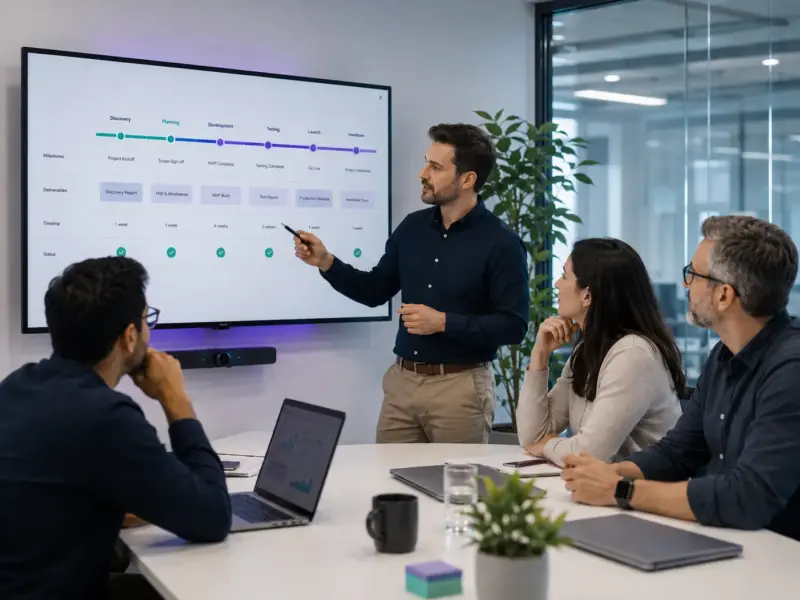
Fixed-Scope Delivery
We own the outcome end to end. Discovery sets scope and architecture, then we build in sprints with a working demo every week.
Best for a defined product with a launch date.
Engagement models
Four engagement models, same engineers either way. What changes is who owns the scope, how long you commit for, and how you pay for it, so start from the shape of the engagement, not from the price.
01 The models
Each one is a different answer to the same question: who is accountable for the outcome, and for how long.
We own the outcome end to end. Discovery sets scope and architecture, then we build in sprints with a working demo every week.
Best for a defined product with a launch date.

A cross-functional pod working only on your roadmap. The same people stay on the product across quarters, so context is never rebuilt.
Best for a long-running product with an evolving roadmap.

Senior engineers who plug into your existing team and process, ramping in weeks and scaling up or down as your roadmap shifts.
Best for an in-house team that needs more hands.

A time-boxed engagement that reviews your data, systems, and use cases, then returns a costed, risk-ranked roadmap you can act on.
Best for deciding where AI is worth it before you build.
02 Compare
The differences that actually decide it are commercial, not technical. These are those.
| Fixed-Scope Delivery Most Chosen | Dedicated Remote Team | IT Staff Augmentation | AI Consulting & Audit | |
|---|---|---|---|---|
| Best for | A defined product with a launch date | A long-running product with an evolving roadmap | An in-house team that needs more hands | Deciding where AI is worth it before you build |
| Term | 8 to 16 weeks, milestone-based | Rolling, three-month minimum | Rolling, one-month minimum | 3 to 6 weeks, fixed |
| Who owns scope | We do, fixed after discovery | You do, we advise | You do, entirely | We do, agreed up front |
| Team | A full pod, staffed by us | Cross-functional pod plus a delivery lead | Individual engineers, inside your process | Principal consultant plus an ML engineer |
| Billing | Fixed price per milestone | Monthly, per seat | Weekly or monthly, per engineer | Fixed fee, two instalments |
| Ramp-up | 2 to 4 week discovery first | 3 to 4 weeks | 2 weeks | Starts within 2 weeks |
| Exit | Documented handover at the final milestone | 30 days' notice | 2 weeks' notice | A costed roadmap, yours to keep |
| Read more | See the model : Fixed-Scope Delivery | See the model : Dedicated Remote Team | See the model : IT Staff Augmentation | See the model : AI Consulting & Audit |
03 Trusted by












04 Questions
Switching models, ownership, notice periods, and starting small.
Yes, and most long-running clients do. A fixed-scope build that turns into an ongoing product usually becomes a dedicated team at handover, same people, new commercial terms. We re-paper the engagement; you do not re-onboard anyone.
You do, in every model, from the first commit. The repository is yours, hosted in your organisation where you want it there, and the licence transfer is in the contract rather than an invoice at the end.
Discovery exists to find that out before the price is fixed, which is why it is billed separately. If something material surfaces mid-build we price the change against the remaining milestones and you decide, we do not absorb it quietly, and we do not stop work while you think about it.
An audit or a two-week discovery is the usual way in. It is a fixed fee, it produces something you keep whatever you do next, and nothing about it obliges you to carry on with us.
Notice is two weeks for staff augmentation, thirty days for a dedicated team, and none for fixed scope work, which simply ends when the scope is delivered. Offboarding includes a handover of code, documentation and access, so nothing you rely on depends on a particular person still being reachable.
05 Start
Describe the work and the timeline. We will tell you which model fits, including when the answer is none of them yet.